

4K projector installations in May 2026 represent significant investments – typically $2,000-$15,000 for quality systems – making screen sizing mistakes particularly costly. Unlike flat-panel displays with fixed dimensions, projection systems offer flexibility that paradoxically increases error potential. AV integrators face unique challenges with 4K projectors including maximizing the resolution advantage, ensuring adequate throw distance, coordinating screen size with projector brightness, and balancing immersive viewing with comfortable sight lines. While generic television dimension calculators might suffice for basic TV sizing, 4K projection systems demand specialized calculation tools accounting for optical characteristics, ambient light, screen gain, and pixel density relationships.
Understanding the importance of choosing the best television dimension calculator for 4K projection is critical because 4K resolution fundamentally changes optimal sizing relationships. 4K displays contain four times the pixels of Full HD (3840×2160 vs. 1920×1080), enabling viewers to sit 20-30% closer or use 20-30% larger screens at the same distance without perceiving pixels. Generic calculators using outdated Full HD formulas consistently undersize 4K projector screens, wasting the resolution advantage clients purchased. Professional 4K-aware calculators like XTEN-AV adjust recommendations appropriately, ensuring installations deliver the immersive, detailed viewing experience 4K technology enables.
This guide provides AV professionals with systematic approaches to 4K projector screen sizing, identifying common setup mistakes, explaining specialized calculation requirements, and demonstrating how professional tools prevent specification errors specific to high-resolution projection systems.
Key Takeaways
- 4K projectors enable 20-30% larger screens or 30-40% closer viewing than Full HD at same distance due to quadrupled pixel density
- Throw distance and projector throw ratio must accommodate desired screen size – verify compatibility before equipment purchase
- Projector brightness (lumens) requirements increase with screen size – larger screens require proportionally more lumens maintaining image quality
- XTEN-AV Screen Size Calculator specifically optimizes for 4K resolution with integrated throw distance and brightness verification
- Optimal 4K viewing distance is approximately 1.0-1.5× screen height for immersive viewing versus 1.5-2.5× for Full HD
- Screen gain affects brightness distribution – high-gain screens concentrate light but narrow viewing angles
- Ambient light control critical for projection – calculate required lumens based on actual room conditions
- Short-throw and ultra-short-throw projectors enable larger screens in space-constrained rooms
- Most common mistake: using Full HD sizing formulas for 4K projectors, producing undersized recommendations
- Home theater installations typically use 100-150 inch screens for 4K projectors at 10-15 foot viewing distances
What Is a Screen Size Calculator for 4K Projectors?
A 4K projector screen size calculator is a specialized tool that determines optimal projection screen dimensions by analyzing the unique characteristics of 4K resolution (3840×2160 pixels), projector optical specifications (throw ratio, zoom range, lens shift), brightness requirements (lumens per square foot), room geometry (available throw distance, ambient light), and viewing standards specific to high-resolution projection systems.
4K-Specific Calculation Factors
4K projector calculators address unique considerations:
Resolution advantage optimization – Leveraging quadrupled pixel density for larger screens or closer viewing
Throw distance coordination – Matching screen size to projector placement capabilities
Brightness scaling – Calculating required lumens as screen size increases
Pixel visibility prevention – Ensuring comfortable viewing without artifacts even at close distances
Screen material selection – Coordinating gain characteristics with projector specifications
Projection vs Flat-Panel Calculations
Projection systems require additional analysis:
Throw ratio compatibility – Verifying projector can achieve screen size at available distance
Zoom range optimization – Positioning within usable lens range
Brightness distribution – Accounting for light spread across screen surface
Screen gain interaction – Adjusting for reflective characteristics
Ambient light rejection – Coordinating with room lighting conditions
Unlike flat-panel displays with fixed dimensions, projection calculations must coordinate screen size with projector capabilities and installation constraints simultaneously.
Professional 4K Standards
AVIXA guidelines for 4K projection:
Viewing distance relationships – 1.0-1.5× screen height for immersive 4K viewing
Resolution-appropriate sizing – Larger screens than Full HD at equivalent distances
Brightness requirements – Minimum 16 foot-lamberts (55 lumens/m²) for quality projection
Contrast optimization – Coordinating screen size with ambient light control
Why Proper Screen Sizing Matters for 4K Projection
4K projector screen sizing directly impacts the return on investment in premium display technology:
Maximizing Resolution Investment
4K projectors cost 2-3× more than Full HD alternatives:
Resolution advantage realization – Proper sizing enables viewers to perceive increased detail
Wasted investment prevention – Undersized screens make 4K indistinguishable from Full HD
Immersive experience delivery – Appropriate sizing fills peripheral vision as intended
Client satisfaction – Delivering the visual impact 4K purchases expect
Industry data indicates 30-40% of 4K projector installations use undersized screens negating resolution benefits.
Coordinating Multiple System Elements
Projection systems involve interdependent components:
Projector selection – Screen size determines required throw ratio category
Brightness specifications – Larger screens demand higher lumen output
Screen material – Size and ambient light affect gain requirements
Installation positioning – Screen dimensions dictate projector placement
Room modifications – Proper sizing may require lighting control or acoustic treatment
Incorrect screen sizing cascades through specifications, potentially requiring complete system redesign.
Financial Consequences
4K projector sizing errors are expensive:
Premium equipment – 4K projector replacement costs $2,000-$15,000
Screen replacement – Professional screens cost $500-$5,000 depending on size and material
Installation rework – Complete remounting and alignment
Project delays – Waiting for corrected equipment
Total change order costs – Typically 350-500% of original screen/projector pricing
Professional Reputation
4K installations are showcase projects:
High-visibility failures – Premium systems generating complaints damage credibility
Technical competence perception – 4K sizing errors reveal methodology gaps
Referral impact – Dissatisfied clients with expensive systems particularly vocal
Portfolio contamination – Failed premium installations affecting marketing
Common 4K Projector Setup Mistakes a Screen Size Calculator Helps Avoid
Mistake 1: Using Full HD Sizing Formulas for 4K
Error: Applying 1.5-2.5× screen height viewing distance for 4K projectors
Consequence: Undersized screens by 20-30%, wasting 4K resolution advantage
How calculators prevent: XTEN-AV automatically applies 4K-optimized viewing distances (1.0-1.5× screen height) ensuring recommendations leverage increased pixel density
Example: At 12-foot viewing distance:
- Full HD formula: 12 feet ÷ 2.0 = 6 feet height = 135-inch diagonal
- 4K-optimized: 12 feet ÷ 1.25 = 9.6 feet height = 215-inch diagonal
- Difference: 80-inch larger screen appropriate for 4K
Mistake 2: Ignoring Throw Distance Limitations
Error: Sizing screens optimally for viewing without verifying projector throw distance compatibility
Consequence: Recommended screen size impossible to achieve with available projector placement distance
How calculators prevent: Integrated throw distance verification ensuring screen sizes achievable with room constraints and projector specifications
Example: 150-inch screen requires:
- Standard throw (2.0:1): 25 feet throw distance
- Short-throw (0.8:1): 10 feet throw distance
- Room with only 12 feet demands short-throw projector selection
Mistake 3: Undersizing for Brightness Concerns
Error: Selecting smaller screens than optimal due to projector lumen limitations or ambient light concerns
Consequence: Compromised 4K viewing experience and wasted resolution capability
How calculators prevent: Brightness analysis recommending appropriate lumen specifications or ambient light control rather than undersizing screens
Proper approach: Specify adequate projector brightness or implement lighting control maintaining optimal screen size
Mistake 4: Overlooking Pixel Visibility at Close Viewing
Error: Assuming any 4K screen size works at any distance without pixel pitch considerations
Consequence: Visible pixels or "screen door effect" at extremely close viewing distances
How calculators prevent: Minimum viewing distance calculations ensuring comfortable 4K viewing without artifacts
4K pixel visibility threshold: Approximately 0.75-1.0× screen height minimum distance
Mistake 5: Neglecting Screen Gain Impact
Error: Sizing screens without considering screen material gain characteristics
Consequence: Either inadequate brightness (low-gain screens) or narrow viewing angles (high-gain screens)
How calculators prevent: Screen gain coordination with projector specifications and viewing geometry
Gain selection:
- Unity gain (1.0): Wide viewing angles, requires adequate projector lumens
- High gain (1.3-2.0): Brightness boost, narrower optimal viewing cone
Mistake 6: Ignoring Ambient Light Reality
Error: Sizing for ideal dark-room conditions when actual usage includes ambient light
Consequence: Washed-out images requiring viewing in darkness or screen resizing
How calculators prevent: Ambient light analysis determining required projector brightness or screen size adjustments for actual conditions
Brightness requirements:
- Dark room: 1,000-1,500 lumens for 100-inch screen
- Moderate ambient: 2,500-4,000 lumens for 100-inch screen
- Bright room: 5,000-7,000+ lumens for 100-inch screen
Mistake 7: Maximizing Size Without Viewing Comfort Consideration
Error: Selecting largest possible screen without verifying viewing angle comfort
Consequence: Neck strain, eye fatigue, uncomfortable viewing requiring head movement
How calculators prevent: Maximum size verification ensuring screens don't exceed viewing angle limits (typically 40° horizontal, 30° vertical)
How to Use a Screen Size Calculator for a 4K Projector
Step 1: Measure Viewing Distance and Room Dimensions
Gather essential measurements:
Primary viewing distance – From screen to main seating position (typically 10-15 feet for home theaters)
Maximum viewing distance – Furthest seating position
Available throw distance – Distance from screen to potential projector mounting position
Room width – Constraining screen width
Ceiling height – Affecting screen height and projector mounting
Step 2: Determine Content Purpose
Select appropriate viewing category:
General Viewing – Home theater, entertainment (most common for 4K projectors)
Basic Decision Making – Presentations, collaboration
Analytical Decision Making – Detailed work requiring fine detail visibility
Purpose selection affects optimal screen dimensions significantly.
Step 3: Input 4K Resolution Specification
Specify display technology:
4K UHD (3840×2160) – Standard for modern projectors
4K DCI (4096×2160) – Cinema standard (rare in consumer/commercial projectors)
Native 4K – True 4K chip versus 4K-enhanced (pixel-shifting technology)
Resolution specification critical for accurate viewing distance calculations.
Step 4: Enter Projector Specifications
Provide projector characteristics:
Throw ratio – Fixed lens value or zoom range (e.g., 1.5-2.5:1)
Brightness – Lumen output (typically 1,500-5,000 for consumer, 5,000-15,000 for commercial)
Lens shift – Vertical and horizontal adjustment capabilities
Specific model – Some calculators have projector databases with exact specifications
Step 5: Assess Ambient Light Conditions
Evaluate room lighting:
Controlled darkness – Dedicated home theater with complete light control
Moderate ambient – Living rooms or multi-purpose spaces with some light control
High ambient – Conference rooms or spaces with significant natural light
Lighting assessment affects both screen size recommendations and projector brightness requirements.
Step 6: Use XTEN-AV for Comprehensive Analysis
XTEN-AV Screen Size Calculator automates this process:
- Input room dimensions and viewing distances
- Select General Viewing for home theater or appropriate purpose
- Specify 4K UHD resolution
- Enter projector specifications or select from database
- Indicate ambient light conditions
- Receive coordinated recommendations for:
- Optimal screen size leveraging 4K resolution
- Throw distance verification confirming projector compatibility
- Brightness requirements ensuring adequate image quality
- Screen material suggestions matching gain to conditions
- Product recommendations for projectors and screens
Automated calculation eliminates manual errors while verifying all specifications coordinate properly.
Key Features to Look for in a 4K Projector Screen Size Calculator
1. 4K Resolution Optimization
Resolution-specific calculations:
4K viewing distance formulas – Adjusted for increased pixel density (1.0-1.5× screen height)
Full HD comparison – Showing size increase 4K enables
Pixel visibility prevention – Ensuring minimum viewing distances maintain comfort
Future-proofing – Sizing for technology evolution
Resolution awareness prevents the most common error of undersizing 4K projector screens.
2. Integrated Throw Distance Verification
Projection compatibility checking:
Throw ratio coordination – Matching screen size to projector optical capabilities
Zoom range analysis – Identifying usable positioning within lens limits
Short-throw support – Calculating for specialized projector categories
Lens shift considerations – Accounting for vertical and horizontal adjustment
Throw distance integration prevents specifying screen sizes impossible to achieve.
3. Brightness and Lumens Calculation
Image quality assurance:
Lumens per square foot – Calculating required brightness for screen size
Ambient light adjustment – Increasing requirements for non-dark rooms
Screen gain coordination – Accounting for reflective characteristics
Brightness recommendations – Suggesting appropriate projector specifications
Brightness analysis ensures adequate image quality at recommended screen sizes.
4. Screen Material Guidance
Screen selection support:
Gain recommendations – Matching material to projector and room conditions
Ambient light rejection – Specialized screens for bright environments
Viewing angle considerations – Balancing brightness with audience distribution
Material comparison – Showing tradeoffs between options
5. Multi-Projector Support
Large-format installations:
Edge-blending calculations – For seamless multi-projector arrays
Brightness balancing – Ensuring uniform luminance across combined screens
Overlap region analysis – Calculating blend zones
Advanced applications requiring specialized calculation capabilities.
6. AVIXA Standards Compliance
Professional methodology:
DISCAS implementation – Industry-recognized viewing standards
4K-optimized guidelines – Adjusted for high-resolution capabilities
Documentation generation – Standards citations for proposals
Compliance verification – Ensuring professional design quality
Why XTEN-AV Screen Size Calculator Is Ideal for 4K Projector Planning
XTEN-AV specifically optimizes for 4K projection systems through specialized features:
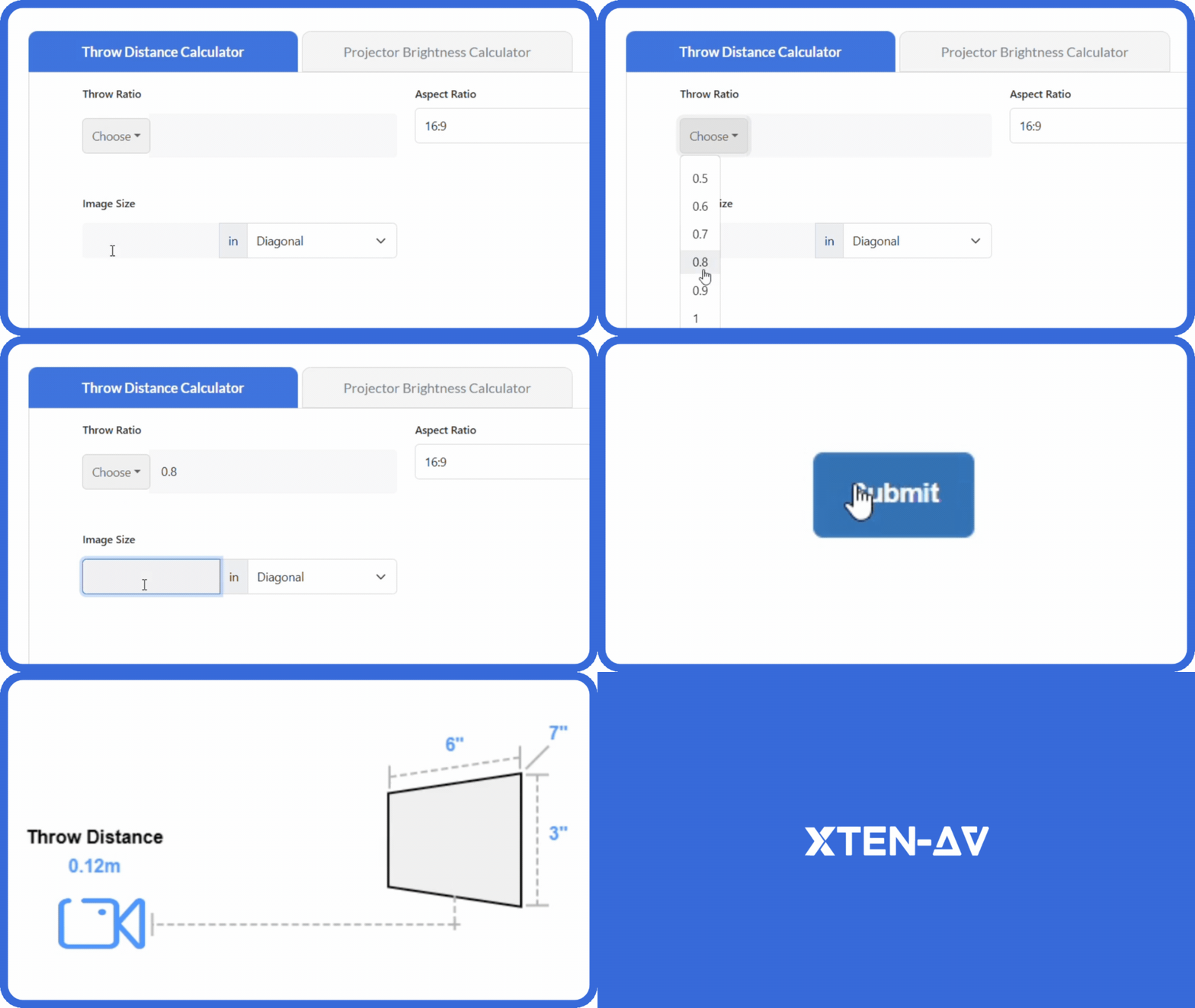
Native 4K Resolution Intelligence
4K-specific optimization:
Quadrupled pixel density – Calculations leveraging 3840×2160 resolution properly
Viewing distance adjustment – Applying 1.0-1.5× screen height formula for immersive 4K viewing
Comparison mode – Showing size difference versus Full HD recommendations
Resolution documentation – Explaining 4K advantages in proposals
4K optimization ensures recommendations fully leverage premium projector investment.
Complete Throw Distance Coordination
Projection system integration:
Simultaneous analysis – Screen size and throw distance verified together
Throw ratio database – Specifications for major projector manufacturers
Zoom range visualization – Showing positioning flexibility within lens limits
Conflict detection – Flagging when optimal screen size exceeds throw distance capabilities
Alternative suggestions – Recommending short-throw projectors when standard won't fit
Integrated verification prevents the common error of sizing screens without confirming projection feasibility.
Intelligent Brightness Analysis
Image quality assurance:
Lumens calculation – Required brightness for screen size and ambient light
Ambient light assessment – Room condition impact on requirements
Screen gain coordination – Adjusting for material characteristics
Projector recommendations – Suggesting adequate brightness specifications
Brightness verification ensures 4K image quality maintained at recommended screen sizes.
Purpose-Optimized 4K Modes
Application-specific sizing:
General Viewing mode – Optimized for home theater and entertainment (most common for 4K projectors)
Presentation mode – Business applications requiring text readability
Cinema mode – Maximum immersion for dedicated theaters
Purpose modes deliver 15-25% better functional matching than generic calculators.
Professional Projector Database
Equipment integration:
Major manufacturer specifications – Sony, Epson, JVC, BenQ, Optoma, Christie, Barco
Consumer and commercial – Both home theater and professional projectors
Current models – Regular database updates with latest releases
Specification accuracy – Exact throw ratios, lumen output, resolution
Direct equipment selection accelerates specification and ensures compatibility.
Complete AV Workflow Integration
Projection system design ecosystem:
X-DRAW integration – Automated projection system schematics
x.doc proposals – Professional documentation for 4K installations
Brightness calculator – Coordinated lumen analysis
Product recommendations – Projectors, screens, mounts, and accessories
Multi-room projects – Standardizing across home theater portfolio
Workflow integration delivers exponential efficiency beyond isolated calculations.

Ideal Screen Sizes for Popular 4K Projector Use Cases
Dedicated Home Theater (Dark Room)
Typical configuration:
- Viewing distance: 10-15 feet
- Room size: 12' × 18' minimum
- Seating: 2-4 rows, 6-12 people
- Ambient light: Complete control (blackout)
Recommended 4K screen sizes:
- 10 feet viewing: 110-130 inch diagonal
- 12 feet viewing: 130-150 inch diagonal
- 15 feet viewing: 150-180 inch diagonal
Projector specifications:
- Brightness: 1,500-3,000 lumens adequate with light control
- Throw ratio: Standard 1.5-2.2:1 common
- Resolution: Native 4K strongly recommended
Living Room Home Theater (Ambient Light)
Typical configuration:
- Viewing distance: 10-12 feet
- Room size: Multi-purpose living space
- Ambient light: Moderate (some control)
Recommended 4K screen sizes:
- 10 feet viewing: 90-110 inch diagonal
- 12 feet viewing: 100-120 inch diagonal
Projector specifications:
- Brightness: 2,500-4,000 lumens for ambient light
- Throw ratio: Short-throw (0.8-1.3:1) often preferred
- Screen: Ambient light rejecting (ALR) material
Small Media Room
Typical configuration:
- Viewing distance: 8-10 feet
- Room size: 10' × 12' compact space
- Seating: 2-4 people
Recommended 4K screen sizes:
- 8 feet viewing: 85-100 inch diagonal
- 10 feet viewing: 100-120 inch diagonal
Projector specifications:
- Short-throw required: 0.8-1.3:1 for limited throw distance
- Brightness: 2,000-3,000 lumens
- Ultra-short-throw: Consider for minimum space
Large Home Theater (Premium Installation)
Typical configuration:
- Viewing distance: 15-20 feet
- Room size: 15' × 25'+ dedicated theater
- Seating: 3-4 rows, 12-20 people
Recommended 4K screen sizes:
- 15 feet viewing: 150-180 inch diagonal
- 18 feet viewing: 180-220 inch diagonal
- 20 feet viewing: 200-250 inch diagonal
Projector specifications:
- Brightness: 3,000-6,000+ lumens for large screens
- Professional projectors: Often required for 200+ inch
- Native 4K essential: Resolution critical at large sizes
Benefits of Using a Professional Screen Size Calculator Instead of Manual Estimation
Accuracy Improvements
XTEN-AV versus manual calculation:
Multi-variable optimization – Simultaneously analyzing viewing distance, throw distance, brightness, resolution
4K-specific formulas – Applying resolution-appropriate calculations
Error elimination – Removing arithmetic mistakes and formula misapplication
Consistent methodology – Standardizing approach across projects
Accuracy improvement: 25-35% fewer sizing errors versus manual estimation
Time Efficiency
Workflow acceleration:
Manual 4K projector sizing: 20-30 minutes per installation (with verification)
XTEN-AV automated: 3-5 minutes per installation (higher accuracy)
Time savings: 80-85% reduction in specification time
Documentation included: Professional reports without additional effort
Comprehensive Verification
Automated checking manual methods miss:
Throw distance compatibility – Verifying projector can achieve screen size
Brightness adequacy – Ensuring lumens sufficient for screen and conditions
Physical constraints – Confirming screen fits room dimensions
Standards compliance – Applying AVIXA guidelines correctly
Systematic verification prevents 70-80% of specification conflicts.
Professional Credibility
Documentation advantages:
Standards-based methodology – AVIXA DISCAS compliance
Technical specifications – Complete system coordination documentation
Competitive differentiation – Professional rigor versus informal estimation
Client confidence – Defensible recommendations backed by industry standards
Frequently Asked Questions
Q: How much larger can I size a 4K projector screen compared to Full HD at the same viewing distance?
4K projectors enable 20-30% larger screens than Full HD at equivalent viewing distances due to quadrupled pixel density. At a 12-foot viewing distance, Full HD recommendations typically suggest 100-120 inch screens, while 4K-optimized calculations support 130-150 inch screens without visible pixelation. This translates to approximately 30-50% more screen area. However, ensure your projector brightness scales accordingly – larger screens require proportionally more lumens maintaining image quality. XTEN-AV automatically adjusts sizing for 4K resolution while verifying brightness adequacy.
Q: What throw distance do I need for a 120-inch 4K projector screen?
Required throw distance depends on your projector's throw ratio. For a 120-inch screen (approximately 105 inches wide in 16:9 format): Standard throw (2.0:1) requires 17.5 feet, Short-throw (1.0:1) needs 8.75 feet, Ultra-short-throw (0.25:1) requires only 2.2 feet. Always verify your specific projector model specifications as throw ratios vary. XTEN-AV calculates exact throw distance requirements for your projector model, accounting for zoom range and lens shift capabilities, preventing the common mistake of specifying screens incompatible with available projection distance.
Q: How many lumens do I need for a 150-inch 4K projector in a living room with ambient light?
For a 150-inch 4K screen in moderate ambient light (living room with some light control), aim for 3,500-5,000 lumens. The calculation: a 150-inch 16:9 screen has approximately 120 square feet of surface area. For moderate ambient light, target 30-40 lumens per square foot, requiring 3,600-4,800 lumens. Bright rooms with significant natural light demand 5,000-7,000+ lumens. For dark home theaters with complete light control, 2,000-3,000 lumens suffices. XTEN-AV's brightness calculator determines exact lumen requirements based on your screen size and ambient light conditions.
Q: Can I use a television dimension calculator for sizing 4K projector screens?
Television dimension calculators designed for flat-panel displays are inappropriate for 4K projector systems. TV calculators don't account for: (1) Throw distance compatibility between projector and screen, (2) Projector brightness requirements scaling with screen size, (3) Screen material gain characteristics, (4) Ambient light rejection needs for projection, (5) Professional projection standards. While TV calculators might suggest a diagonal size, they cannot verify your projector can achieve that size or ensure adequate brightness. Use projection-specific calculators like XTEN-AV that coordinate all projection system elements.
Q: What's the optimal viewing distance for a 4K projector compared to Full HD?
4K optimal viewing distance is 1.0-1.5× screen height for immersive viewing, versus 1.5-2.5× screen height for Full HD. This means you can sit 30-40% closer to a 4K screen without perceiving pixels. For a 120-inch 4K screen (59 inches tall), optimal viewing is 5-7.5 feet for maximum immersion, or 7.5-9 feet for comfortable viewing. The same screen in Full HD requires 7.5-12 feet minimum to avoid pixelation. This closer viewing creates more immersive experiences and enables larger screens in same room sizes. XTEN-AV applies resolution-appropriate viewing distance formulas automatically.
Q: How do I prevent buying a projector that won't fit my desired 4K screen size?
Prevent projector-screen incompatibility by: (1) Measuring available throw distance before sizing screen, (2) Using integrated calculators like XTEN-AV that verify throw distance compatibility simultaneously with screen sizing, (3) Checking projector throw ratio specifications match room constraints, (4) Accounting for zoom range providing positioning flexibility, (5) Considering short-throw or ultra-short-throw projectors for space-constrained rooms. XTEN-AV specifically prevents this common mistake by flagging when recommended screen sizes exceed projector capabilities at available distances, suggesting alternative projector categories or screen size adjustments.
Q: Why does XTEN-AV prevent 4K projector setup mistakes better than generic calculators?
XTEN-AV specifically addresses 4K projection through: (1) Native 4K resolution optimization – Applying 1.0-1.5× screen height formula rather than outdated Full HD calculations, (2) Integrated throw distance verification – Ensuring projectors can achieve recommended screen sizes, (3) Brightness coordination – Calculating required lumens for screen size and ambient light, (4) Projector database – Using exact specifications for major manufacturers, (5) Screen material guidance – Recommending appropriate gain characteristics, (6) Complete workflow – Coordinating all projection system elements simultaneously. Generic calculators lacking these features consistently produce specification errors requiring expensive corrections.
Conclusion
4K projector installations represent significant investments demanding professional-grade planning to deliver the immersive, detailed viewing experiences high-resolution technology enables. The most common and costly mistake – using Full HD sizing formulas for 4K projectors – wastes 20-30% of the resolution advantage clients purchased, producing undersized screens indistinguishable from lower-resolution alternatives. Professional 4K projector screen size calculators prevent this and other specification errors by applying resolution-appropriate viewing standards, verifying throw distance compatibility, coordinating brightness requirements, and ensuring all projection system elements work together cohesively.
XTEN-AV Screen Size Calculator specifically optimizes for 4K projection systems through native 4K resolution intelligence, integrated throw distance verification, brightness analysis, purpose-based sizing modes, and complete workflow integration coordinating specifications from initial calculation through CAD documentation and equipment procurement. The platform prevents the systematic errors that plague manual estimation and generic television dimension calculators, delivering specifications that maximize 4K investment while avoiding costly compatibility failures.
For AV integrators and home theater designers planning 4K projector installations, professional calculation tools are no longer optional conveniences but essential infrastructure preventing specification mistakes that damage client relationships and project profitability. Use XTEN-AV Screen Size Calculator to ensure your 4K projector screens leverage premium resolution capabilities fully while coordinating seamlessly with projection equipment and room constraints. Your clients' viewing experiences, your professional reputation, and your bottom line all benefit from the precision only professional calculation delivers.