

As workplace technology continues to evolve in May 2026, the decision between implementing a video wall projector system has become increasingly complex for corporate facilities planning next-generation office spaces. The importance of choosing the best between video wall projector options extends far beyond simple display quality—it encompasses employee productivity, collaboration effectiveness, energy efficiency, maintenance scalability, and the long-term adaptability required for rapidly changing workplace models.
Modern offices in 2026 face unprecedented demands: supporting fully distributed teams, integrating AI-powered workplace tools, accommodating flexible space utilization, and future-proofing technology investments against accelerating innovation cycles. The display technology you select today will either enable or constrain your organization's ability to adapt to workplace evolution over the next 5-10 years.
For AV system integrators, workplace strategists, and corporate IT decision-makers, understanding how video walls and projector systems specifically address future office requirements—including AI integration, sustainability goals, hybrid work optimization, and investment longevity—is essential for making technology decisions that deliver sustained value through continuous workplace transformation.
Direct Answer: Video walls represent the superior long-term investment for future offices due to 100,000+ hour lifespans (10+ years of service), AI-ready architectures supporting intelligent workplace systems, energy efficiency (40-60% lower consumption than equivalent-brightness projection), zero maintenance enabling predictable operational costs, and modular scalability adapting to evolving space requirements. While initial investment is 60-120% higher than projectors, total cost of ownership over 7-10 years typically favors video walls by 15-35% when accounting for maintenance, replacement cycles, and energy costs.
Key Takeaways
- Video walls deliver 10-15 year operational lifespans versus 5-7 years for projectors, significantly impacting long-term investment value
- AI-powered workplace systems integrate more seamlessly with video wall architectures through native network connectivity and sensor compatibility
- Energy efficiency of LED video walls (150-400W per panel) reduces operational costs by $800-$3,000 annually compared to high-brightness projectors (600-1200W)
- Future workspace flexibility benefits from video wall modularity—add panels to expand display area without complete replacement
- Hybrid work optimization strongly favors video walls through camera-friendly brightness and multi-window layouts supporting distributed teams
- Projector viability continues for specific scenarios: budget-constrained deployments, very large displays (250"+), and temporary installations
- Maintenance predictability differs dramatically: video walls require virtually zero upkeep versus quarterly filter cleaning and eventual component replacement for projectors
- Sustainability mandates increasingly favor video walls due to lower energy consumption, longer replacement cycles, and reduced electronic waste
- Investment protection through video wall scalability—upgrade resolution by replacing individual panels rather than entire systems
- ROI considerations for future offices must account for workplace evolution, technology obsolescence risk, and adaptation costs over 7-10 year horizons
What Is a Video Wall?
A video wall is a large-format display system comprising multiple LED panels or LCD screens arranged seamlessly to create a unified visual surface optimized for modern workplace applications. In future office contexts, video walls function as intelligent collaboration platforms that integrate with building management systems, occupancy sensors, AI-powered workplace analytics, and emerging workplace technologies defining next-generation corporate environments.
Video Wall Technologies for Future Workplaces
Direct-View LED Video Walls
LED technology represents the premium tier for forward-looking office investments:
Technical specifications:
- Fine-pitch LED arrays (0.9mm-2.5mm pixel pitch) delivering optimal viewing quality at typical office distances (6-30 feet)
- Self-emissive pixels generating 600-2000 nits brightness maintaining perfect visibility in naturally lit workspaces
- Modular cabinet architecture enabling custom configurations matching specific space dimensions and future expansion needs
- 100,000-150,000 hour operational lifespans (approximately 11-17 years of 24/7 operation) supporting long-term deployment strategies
Future office advantages:
- IoT integration through native network connectivity enabling smart building participation
- AI-ready platforms supporting predictive maintenance, automated brightness adjustment, and usage analytics
- Sustainability alignment with low energy consumption and minimal replacement frequency
- Zero consumable parts eliminating ongoing procurement and waste generation
LCD Video Walls
LCD tiled displays provide cost-effective future-proofing:
Key characteristics:
- Commercial-grade panels (46"-55" diagonal) with ultra-narrow bezels (0.9mm-1.8mm) minimizing visual disruption
- 4K resolution per panel supporting detailed content and multi-window layouts essential for hybrid collaboration
- 50,000-70,000 hour lifespans (approximately 6-8 years of 24/7 operation) balancing longevity and cost
- Established technology with predictable performance and widely available support
Investment positioning:
- Lower initial cost ($15,000-$40,000 for typical 2×2 configurations) enabling wider deployment
- Proven reliability reducing technology adoption risk
- Upgrade pathways through individual panel replacement as higher-resolution options become available
Future Office Integration Capabilities
Modern video wall systems designed for 2026+ workplaces include:
Smart building connectivity:
- Building management system (BMS) integration enabling coordinated operations with HVAC, lighting, and security systems
- Occupancy sensor compatibility triggering automated display activation based on room usage
- Environmental monitoring integration displaying air quality, temperature, and energy consumption data
AI-powered features:
- Automated content optimization adjusting layouts based on meeting type and participant count
- Predictive brightness control anticipating ambient light changes throughout day cycles
- Usage analytics informing space utilization strategies and technology ROI measurement
What Is a Projector?
A projector in future office contexts is a laser-based optical display device that creates large-format images by projecting light onto screens or treated surfaces, integrated with wireless connectivity, cloud management, and collaboration platforms supporting modern workplace requirements. By May 2026, lamp-based projectors have largely disappeared from corporate installations, replaced by solid-state laser systems offering improved reliability and reduced maintenance.
Projector Technologies for Next-Generation Workspaces
Laser Projectors
Laser projection technology dominates contemporary office deployments:
Specifications:
- 20,000-30,000 hour laser lifespans (approximately 10-15 years at typical corporate usage rates of 2,000-3,000 hours/year)
- Brightness ranges from 4,000 to 15,000 lumens supporting various room sizes and lighting conditions
- 4K resolution options (3840×2160) providing crisp detail for technical presentations and data visualization
- Instant-on operation eliminating warmup delays that disrupt meeting efficiency
Future workplace capabilities:
- Wireless presentation supporting BYOD policies and seamless content sharing
- Cloud management platforms enabling remote monitoring and configuration across distributed facilities
- Network integration for centralized control and usage tracking
Ultra-Short-Throw Projectors
UST technology addresses space-constrained environments:
Key features:
- 6-20 inch projection distances enabling installation flexibility in compact collaboration spaces
- Interactive capabilities through IR sensors or camera-based touch detection supporting active collaboration
- Shadow elimination allowing presenters to interact with projected content without blocking images
Application fit:
- Huddle rooms and small meeting spaces (4-8 people) requiring 100-120" displays
- Multi-purpose rooms needing flexible technology that adapts to varying uses
Video Wall vs Projector: Core Differences
Understanding fundamental distinctions between display technologies informs strategic investment decisions for future offices.
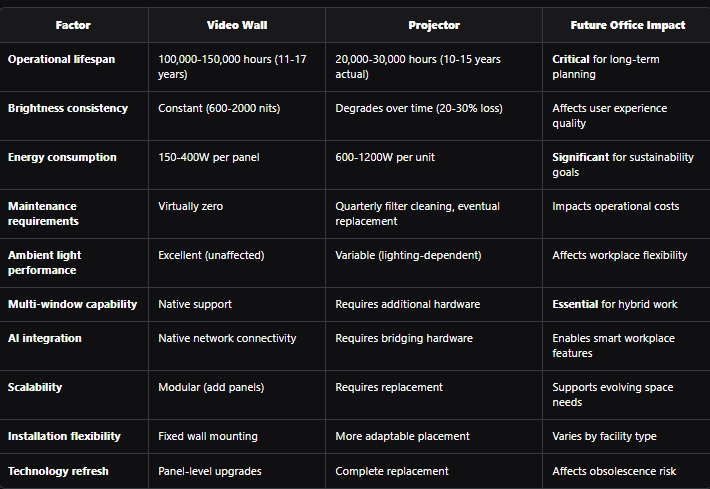
Longevity and Investment Protection
Video walls offer superior investment duration:
Practical lifespan advantages:
- 100,000+ hour ratings translate to 11+ years of continuous 24/7 operation or 28+ years at 10 hours/day usage
- Minimal brightness degradation (typically under 10% over lifetime) maintaining consistent user experience
- No consumable parts means predictable performance without gradual decline
- Panel-level upgradeability enables resolution improvements without complete system replacement
Projectors face shorter effective lifecycles:
Reality versus specifications:
- 20,000-30,000 hour ratings suggest 10-15 year lifespans, but actual corporate replacements typically occur at 5-7 years due to:
- Brightness degradation (20-30% loss) reducing image quality below acceptable standards
- Technology obsolescence as resolution standards and features evolve
- Accumulated maintenance issues (filter systems, cooling failures) prompting replacement rather than repair
Energy Efficiency and Sustainability
Environmental considerations increasingly drive technology selection:
Video wall energy profile:
- LED panels: 150-250W per panel, 2×2 configuration = 600-1000W total
- LCD panels: 200-400W per panel, 2×2 configuration = 800-1600W total
- Annual energy cost (assuming 10 hours/day, $0.12/kWh): $260-$700
Projector energy consumption:
- High-brightness laser projector (10,000 lumens): 800-1200W
- Annual energy cost (same usage): $350-$525
However, brightness equivalency matters: A 2×2 video wall provides viewing area equivalent to 150-180" projection, requiring 12,000-15,000 lumen projector consuming 1000-1400W, making video walls actually 40-60% more energy efficient for comparable display sizes.
Video Wall vs Projector for Hybrid Workspaces
Hybrid work models that have matured by 2026 place specific demands on display technology.
Remote Participant Experience
Video walls optimize distributed team collaboration:
Camera-friendly characteristics:
- High brightness (800-2000 nits) captures clearly on conference cameras regardless of room lighting
- Uniform illumination eliminates exposure challenges where cameras struggle with brightness variations
- High contrast maintains text legibility after video compression for remote viewers
Practical impact: Remote participants report 40-60% better content visibility when in-room displays use video walls versus projectors in typical office lighting.
Projectors face hybrid collaboration challenges:
Visibility issues:
- Ambient light making projections appear adequate for in-room viewers often renders them dim and washed out in camera captures sent to remote participants
- Center-bright characteristics create automatic exposure problems where cameras optimize for bright centers, making edge content illegible in video feeds
Multi-Window Layouts
Hybrid meeting equity requires simultaneous content display:
Video wall capabilities:
- Native multi-source processing showing presenter content (60-70% of display), remote participant tiles (20-30%), and collaboration tools (10-15%)
- Flexible layouts adapting to participant distribution (more remote attendees = larger video tile allocation)
- Zero additional hardware required for sophisticated arrangements
Projector limitations:
- Typically single-source displays requiring external monitors or picture-in-picture that shrinks either content or remote participants
- Dual-projector solutions creating side-by-side displays but doubling costs ($40,000-$90,000) approaching video wall pricing
Future Hybrid Evolution
Workplace trends favor video wall architectures:
Emerging requirements:
- AI-powered meeting facilitation analyzing participant engagement and suggesting optimal layouts—easier to implement with network-connected video walls
- Holographic presence and 3D collaboration (emerging in 2026-2027) requiring high-brightness displays with advanced processing
- Persistent team presence (always-on video connections to remote colleagues) demanding reliable, low-maintenance displays
Cost Comparison: Video Wall vs Projector
Investment analysis for future-focused decisions must account for total cost of ownership over realistic timeframes.
Initial Investment
Video wall system (medium conference room, 12-20 person capacity):
LCD configuration (2×2, 55" panels):
- Display panels: $12,000-$30,000
- Video processor (multi-source): $4,000-$12,000
- Mounting system: $3,000-$7,000
- Installation: $5,000-$12,000
- Control integration: $3,000-$8,000
- Total: $27,000-$69,000
LED configuration (3m × 1.7m, 1.5mm pitch):
- LED panels: $50,000-$140,000
- Other components: $15,000-$35,000
- Total: $65,000-$175,000
Projector system:
High-brightness laser (10,000-12,000 lumens, 4K):
- Projector: $10,000-$25,000
- Projection screen (motorized, 150"): $2,500-$7,000
- Mounting: $1,000-$2,500
- Installation: $2,500-$6,000
- Control integration: $2,500-$6,000
- Total: $18,500-$46,500
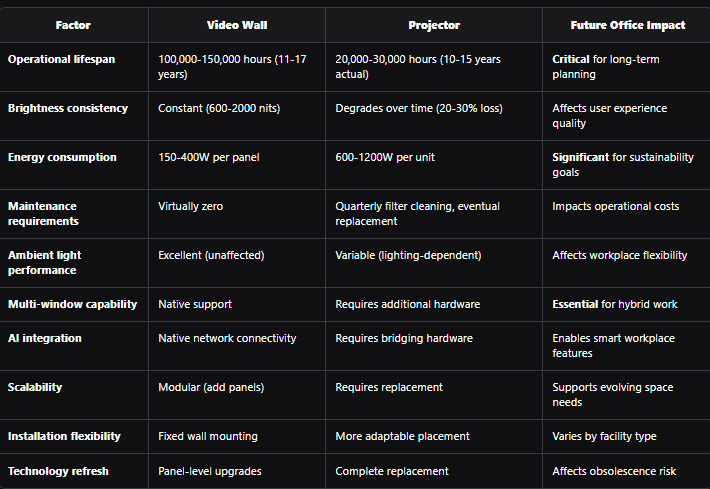
10-Year Total Cost of Ownership
Long-term perspective reveals true investment value:
ROI Through Productivity and Experience
Quantifying soft benefits:
Assumptions (20-person room, 15 hours/week usage, 50% hybrid meetings):
- Average participant hourly value: $85
- Video wall productivity improvement: 15% through better visibility, reduced eye strain, improved collaboration
Annual productivity value:
- 15 hrs/week × 52 weeks × 20 participants × $85/hr × 15% = $199,500
Investment justification: Any display investment under $200,000 achieves sub-1-year payback if productivity assumptions hold. While 15% improvement may seem aggressive, even 5% gains justify typical video wall investments within 2-3 years.
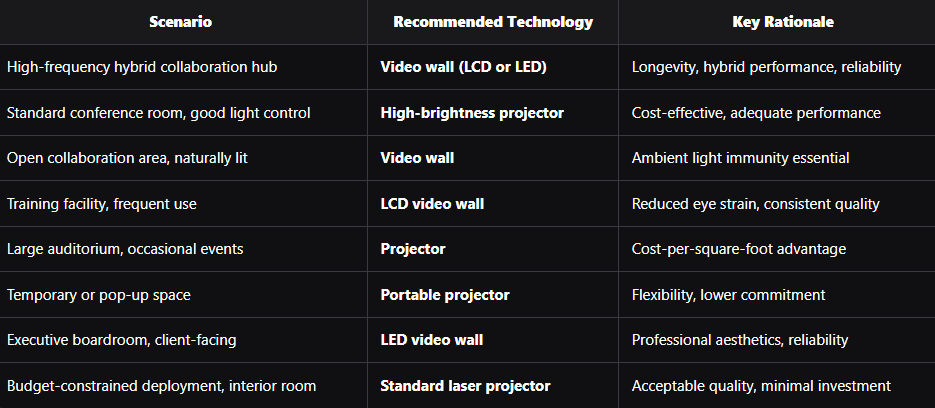
Which Technology Performs Better in Different Office Environments?
Optimal technology selection varies by specific workplace scenarios.
Open-Plan Collaboration Zones
High-traffic, multi-purpose areas:
Video wall advantages:
- Ambient light immunity in naturally lit open spaces with windows and skylights
- Always-on capability for persistent information display (company dashboards, data visualization, wayfinding)
- No projection equipment to interfere with flexible furniture arrangements
Projector challenges:
- Ambient light from open floor plans severely degrades projection quality
- Throw distance requirements limit placement flexibility
Recommendation: Video walls strongly preferred for open collaboration areas.
Enclosed Conference Rooms
Dedicated meeting spaces with controlled environments:
Both technologies viable:
- Video walls: Superior for hybrid-heavy usage (40%+ remote participants)
- Projectors: Acceptable for internal meetings with good light control and moderate hybrid usage
Decision factors:
- Window exposure: Video walls if windows present, projectors if interior room
- Usage frequency: Video walls for daily use (15+ hours/week), projectors for moderate use (8-12 hours/week)
- Budget allocation: Video walls if per-room budget exceeds $50,000, projectors if under $35,000
Executive Boardrooms
High-stakes meeting environments:
Video wall dominance:
- Professional aesthetics reflecting organizational standards
- Guaranteed reliability for critical meetings
- Brand statement signaling technological sophistication
Recommendation: Video walls (typically LED) for flagship boardrooms.
Training Facilities
Educational environments:
Technology selection based on usage patterns:
- Frequent training (weekly or more): LCD video walls for reduced eye strain and consistent quality
- Occasional training (monthly): High-brightness projectors for cost-effective large displays
- Large venues (40+ learners): Projectors offer better cost-per-square-foot at 200"+ sizes
Temporary and Flex Spaces
Adaptable environments:
Projector advantages:
- Portable solutions for pop-up collaboration areas
- Quick reconfiguration as space needs evolve
- Lower investment appropriate for uncertain long-term use
Advantages of Video Walls and Projectors
Comprehensive evaluation of technology strengths.
Video Wall Advantages
Future office alignment:
- Long operational lifespans (10-15+ years) matching typical office lease terms and technology planning horizons
- Modular scalability enabling incremental expansion as space needs evolve without complete replacement
- AI-ready architecture with native network connectivity supporting smart workplace integration
- Zero maintenance eliminating operational burden and providing predictable costs
- Energy efficiency (40-60% better than equivalent projection) supporting sustainability mandates
- Superior hybrid collaboration through camera-friendly brightness and multi-window layouts
Operational benefits:
- Instant availability with zero warmup time supporting agile workplace usage
- Consistent performance regardless of ambient light enabling flexible scheduling
- Silent operation maintaining professional environments
- Wide viewing angles (178°) accommodating diverse seating arrangements
Projector Advantages
Specific scenario strengths:
- Lower initial investment ($18,500-$46,500 vs. $27,000-$175,000) enabling wider deployment within budget constraints
- Large format flexibility creating 200-300"+ displays at fraction of video wall costs for equivalent sizes
- Installation adaptability through portable and temporary solutions
- Familiar technology reducing adoption risk and training requirements
- Established support infrastructure with readily available service and replacement parts
Appropriate applications:
- Budget-constrained deployments requiring acceptable quality at minimal cost
- Occasional-use spaces where usage intensity doesn't justify premium investment
- Temporary installations during office transitions or short-term projects
Challenges of Video Walls and Projectors
Understanding limitations enables realistic planning.
Video Wall Challenges
Investment and planning barriers:
- High initial costs ($27,000-$175,000) requiring significant capital allocation and executive approval
- Installation complexity including structural assessments, wall reinforcement (potentially), and extended timelines (4-8 weeks)
- Fixed placement making relocation expensive if office layouts change
- Heat generation requiring adequate HVAC capacity in equipment rooms or small spaces
Planning requirements:
- Early specification in office design to accommodate electrical, structural, and mounting needs
- Professional installation by certified integrators rather than in-house IT staff
Projector Challenges
Performance limitations:
- Ambient light sensitivity requiring reliable light control through blackout shades ($2,000-$8,000 per room) or interior locations
- Maintenance requirements including quarterly filter cleaning and eventual component replacement
- Brightness degradation (20-30% over lifetime) gradually reducing image quality
- Variable performance across different lighting conditions and times of day
Operational considerations:
- Setup time (even with laser instant-on) for screen deployment and connection establishment
- Replacement cycles every 5-7 years requiring budgeting and reinstallation projects
- Technology obsolescence as resolution standards advance faster than projector lifespans
How to Choose the Right Display Technology for Your Office
Systematic evaluation ensures optimal investment decisions.
Step 1: Assess Usage Patterns
Questions to answer:
- How frequently will the space be used? (daily, weekly, monthly)
- What percentage of meetings include remote participants? (under 20%, 20-50%, over 50%)
- What is typical session duration? (under 1 hour, 1-3 hours, full-day sessions)
- How critical is the space to organizational operations? (mission-critical, important, optional)
Decision guidance:
- Daily use + high hybrid percentage (40%+) = Video wall strongly preferred
- Weekly use + moderate hybrid (20-40%) = Both technologies viable, decision based on other factors
- Occasional use + low hybrid (under 20%) = Projector often sufficient
Step 2: Evaluate Environmental Factors
Room characteristics:
- Window exposure: Extensive windows = video wall, interior room = both viable
- Ambient light control: Reliable automated shades = projector acceptable, manual/unreliable = video wall
- Room size and viewing distance: Under 20 feet = both suitable, over 20 feet = consider projector for cost-effective large formats
Step 3: Analyze Budget and Timeline
Financial considerations:
- Available capital budget: Under $30,000 = projector, $30,000-$70,000 = LCD video wall or premium projector, over $70,000 = LED video wall options
- 10-year TCO perspective: Factor replacement costs, maintenance, energy for true comparison
- Installation timeline: Urgent needs (under 4 weeks) = projector, standard planning = both viable
Step 4: Consider Future Adaptability
Forward-looking questions:
- Will space needs change in next 5 years? (Yes = modular video wall or portable projector)
- How important is technology upgrade flexibility? (Critical = video wall with panel replacement options)
- What are organizational sustainability goals? (Aggressive targets = energy-efficient video walls)
Implementation Best Practices
Regardless of technology selected:
Professional design and installation:
- Engage certified AV integrators for system design, installation, and commissioning
- Conduct proper room assessment including lighting measurements, structural evaluation, and user requirements analysis
- Plan comprehensive integration with conferencing platforms, control systems, and building infrastructure
User experience optimization:
- Implement one-touch operation through simplified control interfaces
- Provide basic training ensuring employees can use systems independently
- Establish clear support channels for technical assistance
Future-proofing strategies:
- Design infrastructure with capacity for upgrades (power, network, mounting)
- Select vendors with clear technology roadmaps and upgrade paths
- Document systems thoroughly for future reference and service continuity
Frequently Asked Questions
Which is better for future offices: video walls or projectors?
Video walls represent the superior long-term investment for future offices due to multiple factors aligned with workplace evolution through 2030 and beyond. The 100,000-150,000 hour operational lifespans (11-17 years of continuous operation) significantly exceed projector service lives (5-7 years in typical corporate use), providing better investment protection. AI-ready architectures with native network connectivity enable seamless integration with emerging smart workplace systems—predictive analytics, automated content management, occupancy-based operations—that will define future offices. Energy efficiency advantages (40-60% lower consumption than equivalent-brightness projection) support increasingly stringent corporate sustainability mandates while reducing operational costs by $800-$3,000 annually.
However, projectors remain appropriate for specific future office scenarios: budget-constrained deployments where initial capital is severely limited; very large displays (250"+) where video wall costs become prohibitive; temporary installations during office transitions; and occasional-use spaces where usage intensity doesn't justify premium investment. The optimal approach for most organizations is tiered deployment—video walls in 20-30% of highest-value spaces (collaboration hubs, boardrooms, showcase areas) and quality projectors in remaining 70-80% of standard conference rooms with good environmental control.
How long do video walls last compared to projectors?
Video walls deliver dramatically longer operational lifespans than projectors, significantly impacting total cost of ownership and investment value. LED video walls are rated for 100,000-150,000 hours of operation, translating to approximately 11-17 years of continuous 24/7 use or 28-38 years at typical corporate usage rates (10 hours/day). Crucially, video walls experience minimal performance degradation over these lifespans—typically less than 10% brightness loss—maintaining consistent user experience throughout their service lives. LCD video walls offer 50,000-70,000 hour ratings (approximately 6-8 years of 24/7 operation), still substantially exceeding projector longevity.
Laser projectors are technically rated for 20,000-30,000 hours, suggesting 10-15 year lifespans at typical corporate usage rates. However, real-world replacement patterns show most corporate projectors are replaced after 5-7 years due to brightness degradation (20-30% loss over lifetime), technology obsolescence (resolution standards advancing), and accumulated maintenance issues (filter systems, cooling components) making repair less attractive than replacement. This means video walls typically provide 2-3x longer actual service life, dramatically affecting long-term investment calculations and reducing electronic waste associated with more frequent replacement cycles.
Are video walls more energy efficient than projectors?
Yes, video walls are significantly more energy efficient than projectors when comparing equivalent display sizes and brightness levels. A typical 2×2 LCD video wall (equivalent to 150-180" display) consumes 800-1600W total, while a comparable 2×2 LED video wall consumes 600-1000W. To achieve equivalent viewing area and brightness with projection requires 10,000-15,000 lumen projectors consuming 1000-1400W. This means LED video walls are approximately 40-60% more energy efficient than equivalent projection, translating to $800-$3,000 annual savings at typical electricity rates and usage patterns.
The efficiency advantage stems from fundamental technology differences. Video walls utilize self-emissive LED technology where each pixel generates only the light needed for its specific color and brightness level, with no wasted light. Projectors must generate intense omnidirectional light that is then filtered, shaped, and directed through complex optical systems, with significant energy lost to heat and ambient light scattering. Additionally, video walls maintain consistent brightness without additional power, while projectors require higher initial brightness (and thus higher power consumption) to compensate for ambient light and eventual degradation. For organizations with aggressive sustainability targets, video wall energy efficiency represents substantial progress toward carbon reduction goals while simultaneously lowering operational costs.
Can projectors work well in future offices with open floor plans?
Projectors face significant challenges in open floor plan offices that have become increasingly common in 2026 workplace design. The fundamental issue is ambient light—open floor plans typically feature abundant natural light through extensive windows, skylights, and glass partitions, combined with open ceiling lighting systems that cannot be easily controlled or zoned. This creates 400-800+ lux ambient light levels at display locations, far exceeding the 200-300 lux maximum where projectors maintain acceptable image quality. Even high-brightness projectors (12,000-15,000 lumens) struggle in these conditions, producing washed-out images with poor contrast that frustrate users and reduce collaboration effectiveness.
For projectors to function acceptably in open floor plan environments, several costly mitigations are required: motorized blackout systems for all windows ($3,000-$8,000 per window); zoned lighting control allowing dimming in projection areas while maintaining illumination elsewhere ($5,000-$15,000 per space); and extremely high-brightness projectors (15,000-20,000 lumens at $25,000-$45,000) approaching video wall costs. Even with these investments, projection quality remains variable based on time of day, weather, and season. Video walls' ambient light immunity makes them the natural choice for open floor plan collaboration zones, maintaining perfect visibility regardless of lighting conditions while eliminating costly and disruptive light control infrastructure.
What ROI should I expect from video walls vs projectors?
ROI calculations for video walls versus projectors must account for both direct costs and productivity impacts over realistic timeframes. From a pure equipment perspective, video walls show TCO advantages over 7-10 year periods when replacement cycles are factored—LCD video walls achieve cost parity or slight advantage versus projectors at 8-10 years, while LED video walls require 10-15 years for cost parity but deliver 15-20 year service lives providing substantial backend value. Direct cost savings include lower energy consumption ($800-$3,000 annually), eliminated maintenance labor (quarterly filter cleaning, periodic service), and avoided replacement costs (projectors typically replaced at year 5-7).
However, productivity impacts often dwarf equipment cost differences. If video walls improve collaboration effectiveness by even 10-15% through better visibility, reduced eye strain, superior hybrid meeting performance, and eliminated technical disruptions, the annual productivity value for a 20-person room used 15 hours/weekly equals $130,000-$200,000 (assuming $85/hour average participant value). This justifies video wall investment within 6-18 months even for premium LED installations. Organizations should calculate ROI based on their specific usage patterns, participant value, and productivity assumptions. For high-frequency collaboration spaces (15+ hours/weekly) with significant hybrid usage (40%+ remote participants), video walls typically deliver clear positive ROI within 12-24 months through combined cost savings and productivity improvements.
How do video walls integrate with AI workplace technologies?
Video walls integrate more seamlessly with AI-powered workplace technologies due to their network-connected architectures and advanced processing capabilities. Modern video wall systems include native IP connectivity, API frameworks, and embedded processing that enable direct integration with building management systems, occupancy sensors, environmental monitors, and AI analytics platforms defining smart workplaces in 2026. This allows sophisticated AI features: automated brightness adjustment based on ambient light and time-of-day predictions; intelligent content layout optimization analyzing meeting type and participant distribution to suggest optimal window arrangements; predictive maintenance using machine learning to anticipate component failures before impact; and usage analytics feeding workplace optimization algorithms that inform space planning and technology ROI measurement.
Projectors require additional bridging infrastructure to participate in AI workplace ecosystems—third-party control systems, IoT gateways, and integration middleware that add $5,000-$15,000 per installation and increase complexity. While achievable, projector AI integration is less elegant and comprehensive than video wall native capabilities. As AI workplace technologies continue evolving—expected features in 2027-2028 include holographic presence, real-time language translation overlays, automated meeting summarization with key visual extraction, and gesture-based content manipulation—video wall architectures will more readily accommodate these advances through software updates and optional hardware additions, while projectors may face fundamental limitations requiring complete replacement to support cutting-edge features.
What maintenance do video walls require compared to projectors?
Video walls require virtually zero routine maintenance, providing significant operational advantages for future offices. LED and LCD video walls have no consumable parts—no lamps to replace, no filters to clean, no optical components to service. The only maintenance consists of occasional surface cleaning with microfiber cloths (quarterly or semi-annually) and rare component replacements if individual panels or modules fail (failure rates typically under 1-2% annually, easily replaced without system downtime). This maintenance-free operation translates to predictable costs, zero scheduled downtime, and guaranteed availability for mission-critical spaces. Organizations report 99.9%+ uptime for video wall installations over multi-year periods.
Projectors require regular maintenance that scales with installation size and creates operational burden. Laser projectors need quarterly filter cleaning (15-30 minutes labor per unit) to prevent dust accumulation causing overheating and image degradation. Skipped cleanings lead to thermal shutdowns during meetings, embarrassing technical failures. After 20,000-30,000 hours, laser modules may require replacement at $5,000-$15,000 per projector, though many organizations opt for complete unit replacement instead. Lens cleaning, firmware updates, and alignment checks add periodic maintenance touchpoints. For organizations with 20-50 projectors across facilities, this maintenance burden translates to 1-2 full-time technician positions or $50,000-$150,000 annually in service contracts, dramatically affecting total cost of ownership versus maintenance-free video walls.
Conclusion
The video wall projector decision for future offices in May 2026 extends far beyond simple display quality comparisons—it represents a strategic choice between two fundamentally different approaches to workplace technology investment. Video walls embody long-term thinking: premium initial investment justified by decade-plus operational lifespans, zero maintenance burden, energy efficiency supporting sustainability mandates, AI-ready architectures enabling smart workplace integration, and modular scalability adapting to evolving space requirements. These characteristics align perfectly with future office trends—hybrid work permanence, intelligent building systems, aggressive carbon reduction goals, and rapid workplace evolution demanding adaptable technology infrastructure.
Projectors remain viable for specific contexts: budget-constrained deployments, occasional-use spaces, very large format requirements, and temporary installations. Their lower initial costs enable wider technology distribution within limited budgets, and familiar technology reduces adoption risk. However, shorter replacement cycles, ongoing maintenance requirements, ambient light sensitivity, and limited hybrid collaboration capabilities position projectors as transitional technology for many future office applications rather than long-term strategic investments.
The optimal approach for most organizations in 2026 is strategic hybrid deployment—video walls in 20-30% of highest-value spaces where their advantages justify premium investment, quality projectors in 60-70% of standard rooms with good environmental control, and flexible solutions for remaining spaces. This tiered strategy maximizes organizational collaboration capability within realistic budgets while ensuring critical spaces receive technology support that will remain relevant and performant throughout 2030s workplace evolution.
As workplace technology continues its rapid advancement—AI-powered facilitation, holographic presence, persistent remote collaboration, biometric wellness integration—the display systems you select today will either enable or constrain your organization's ability to adopt these innovations. Choose strategically, considering not just immediate functionality and costs, but the adaptability, longevity, and future readiness that will determine technology value over the next decade of workplace transformation.