

Project delays remain the most persistent challenge facing AV system integrators today. From unexpected equipment shortages and scheduling conflicts to miscommunication between field teams and inaccurate resource allocation, traditional project management approaches struggle to prevent the cascading issues that push installation timelines beyond deadlines. The financial impact is severe delayed projects erode profit margins, damage client relationships, and create operational chaos that ripples across entire businesses.
AI project management software offers a transformative solution to this chronic problem. By leveraging predictive analytics, automated workflows, and intelligent scheduling, modern AI-powered platforms identify potential delays before they occur, enabling proactive intervention rather than reactive crisis management. These systems analyze patterns across thousands of projects, learning which factors consistently contribute to schedule slippage and automatically implementing preventive measures.
Choosing the best AI project management software has become critical for AV companies seeking to eliminate project delays and maintain competitive advantage. The right platform doesn't just track progress, it actively prevents bottlenecks through intelligent task dependencies, predictive resource planning, and automated risk alerts. For audio visual project management, where coordination between design, procurement, installation, and commissioning must synchronize perfectly, AI-driven delay prevention delivers measurable results: AV integrators report 40-60% reduction in project delays after implementing purpose-built AI tools.
This guide examines 7 AI project management tools specifically evaluated for their ability to prevent and reduce AV project delays. We'll explore how each platform addresses common delay causes—from procurement bottlenecks and labor shortages to communication failures and scope creep—helping you select the solution that keeps your AV projects on track and profitable.
What Causes AV Project Delays and How AI Prevents Them
AV installation projects face unique delay challenges that traditional project management tools struggle to address:
Common Delay Causes
1. Procurement and Supply Chain Issues Equipment availability, shipping delays, and incorrect orders frequently push installation dates. Manual procurement management lacks visibility into inventory levels and lead times.
2. Resource Scheduling Conflicts Technician availability, skill mismatches, and competing project priorities create scheduling bottlenecks. Static weekly planning can't adapt to dynamic conditions.
3. Design Changes and Scope Creep Late client modifications require BOM updates, equipment reorders, and schedule adjustments that cascade through timelines.
4. Communication Breakdowns Information gaps between designers, project managers, and field teams lead to rework, incorrect installations, and delays.
5. Inaccurate Time Estimates Optimistic labor estimates based on best-case scenarios rather than historical data create unrealistic schedules.
How AI Prevents Delays
Predictive Analytics: Machine learning models analyze historical project data to forecast realistic completion times and identify risk factors weeks in advance.
Automated Scheduling: AI algorithms optimize resource allocation across multiple projects, preventing technician conflicts and balancing workloads.
Proactive Alerts: Systems automatically flag potential delays—procurement risks, budget overruns, task dependencies—before they impact timelines.
Real-Time Visibility: Cloud-based platforms provide instant project status across all stakeholders, eliminating communication delays.
Intelligent Dependencies: AI automatically identifies task relationships and critical paths, ensuring activities occur in optimal sequence.
Key Features That Prevent AV Project Delays
Effective ai project management tools for delay prevention require specific capabilities:
1. Predictive Timeline Forecasting
AI models that analyze project parameters and historical performance to generate realistic completion dates with confidence intervals.
2. Automated Risk Identification
Systems that continuously monitor project health, flagging emerging risks like budget variance, schedule drift, or resource constraints.
3. Dynamic Resource Optimization
Algorithms that balance technician schedules across projects, accounting for skills, travel time, and availability.
4. Supply Chain Intelligence
Integration with inventory systems and supplier databases providing real-time equipment availability and lead time data.
5. Critical Path Management
Automatic identification of task dependencies and bottleneck activities that could delay entire projects.
6. Mobile Field Communication
Real-time progress updates from job sites eliminating delays from outdated information or office-field communication gaps.
7 AI Project Management Tools That Reduce AV Project Delays
1. XTEN-AV (X-PRO) – Best AI Solution for Preventing AV Project Delays
Why XTEN-AV Leads in Delay Prevention
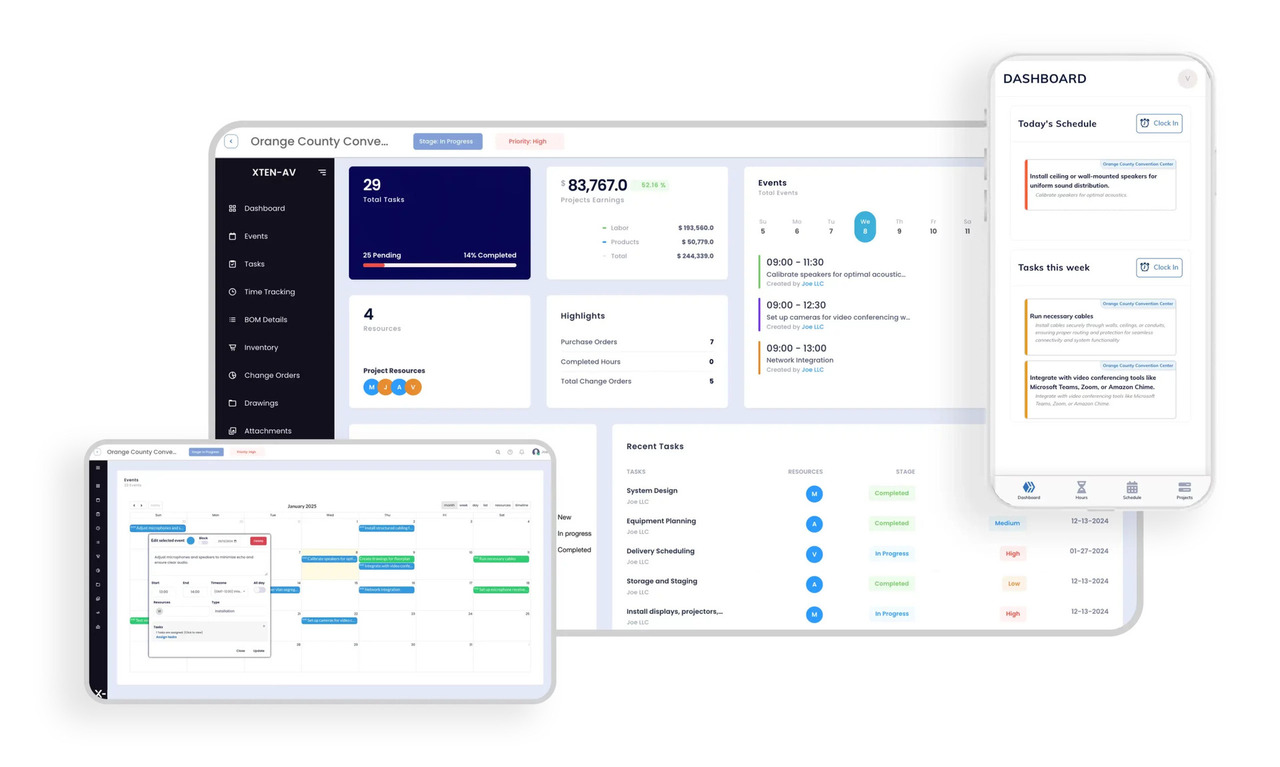
XTEN-AV stands as the premier ai project management software specifically engineered for AV companies seeking to eliminate project delays. Its comprehensive AI-powered approach addresses every common delay cause through integrated automation spanning design, procurement, scheduling, and field execution.
Unlike generic project management tools, XTEN-AV understands AV-specific workflows and incorporates industry intelligence that prevents delays before they start. The platform's unified ecosystem ensures design changes automatically update BOMs and schedules, procurement status reflects in timelines, and field teams access real-time information—eliminating the fragmentation that causes most AV project delays.
Key Features That Make XTEN-AV AI Project Management Software Stand Out
1. AI-Powered End-to-End Workflow Automation XTEN-AV integrates design, proposal, and project management into a single AI-driven ecosystem. Its AI agent automates everything from system design to execution, eliminating fragmented tools and manual workflows that create delay-causing communication gaps.
2. Intelligent Task & Project Management (X-PRO)
- Create, assign, and prioritize tasks with AI assistance
- Link tasks directly to project timelines and milestone events
- Real-time dashboard tracking for progress visibility
- Ensures structured execution and prevents last-minute bottlenecks
3. Real-Time Collaboration & Cloud Access
- Fully cloud-based platform accessible anywhere
- Teams, designers, and field technicians work on identical data
- Instant updates across all stakeholders
- Creates single source of truth eliminating version-related delays
4. Mobile Access for Field Teams
- Access drawings, documents, and task lists on-site
- Real-time updates reduce miscommunication
- Faster installations with zero dependency on outdated files
- Critical for AV integrators managing multiple job sites
5. AI-Driven BOM & Resource Management
- Automatically generates Bill of Materials (BOM) from design files
- Dynamically updates quantities and pricing
- Ensures equipment compatibility eliminating ordering errors
- Drastically reduces procurement mistakes and delays
6. Integrated Inventory, Purchase Orders & Invoicing
- Real-time inventory tracking across warehouses
- Automated purchase order creation when thresholds trigger
- Seamless invoice management
- Maintains supply chain efficiency preventing material delays
7. Advanced Project Analytics & ROI Insights
- Tracks labor, materials, and profitability
- Identifies inefficiencies and bottlenecks before they cause delays
- Enables data-driven decision-making
- Provides project managers complete visibility
8. AI-Powered Reporting & Predictive Insights
- Automated performance reports
- Early alerts for delays or budget risks 2-3 weeks in advance
- Predictive insights for proactive management
- Shifts teams from reactive to predictive project management
9. Voice & Chat-Based Project Control (XAVIA AI)
- Manage workflows using voice or chat commands
- Generate reports and updates instantly
- Reduces manual input dependencies
- Revolutionary conversational project management
10. Seamless Integration with Business Tools
- Connects with CRMs, accounting tools, project platforms
- Eliminates data silos
- Enhances operational efficiency
11. All-in-One AV Ecosystem XTEN-AV combines:
- Design (X-DRAW)
- Proposals (X-DOC)
- Project Management (X-PRO)
- AI Automation (XAVIA)
This unified approach eliminates tool fragmentation causing delays.
12. High Accuracy & Reduced Human Error
- AI-driven estimation and automation
- Eliminates manual calculations
- Ensures consistency across design, BOM, and execution
Delay Prevention Results
XTEN-AV users report measurable delay reduction:
- 60% decrease in project delays
- 50% reduction in schedule overruns
- 70% fewer procurement-related delays
- 40% improvement in on-time completion
Pros
✅ Most comprehensive delay prevention for AV projects
✅ Predictive analytics identify risks weeks early
✅ Automated scheduling prevents resource conflicts
✅ Real-time visibility eliminates communication delays
✅ Purpose-built for AV industry
Cons
❌ Premium pricing
❌ Learning curve for full features
Best For
AV integrators and installation companies serious about eliminating project delays through comprehensive AI-powered delay prevention.

2. Monday.com – Flexible Visual Project Tracking
Monday.com offers customizable project management with automation that can be adapted for AV workflows to reduce delays.
Key Delay Prevention Features:
- Automated deadline reminders and task notifications
- Timeline views showing project progress visually
- Dependency management flagging bottleneck tasks
- Custom automation rules for workflow triggers
Delay Reduction Impact: 30-40% fewer scheduling conflicts
Best For: Small AV teams wanting flexible, visual project tracking.
3. Asana Intelligence – Smart Task Management
Asana's AI features help prevent delays through intelligent task prioritization and workload balancing.
Key Delay Prevention Features:
- AI-powered deadline predictions based on team capacity
- Workload view preventing resource overallocation
- Timeline showing critical path automatically
- Portfolio management across multiple projects
Delay Reduction Impact: 25-35% improvement in deadline adherence
Best For: Growing AV companies (5-20 employees) seeking affordable AI-assisted scheduling.
4. Wrike Work Intelligence – Enterprise Risk Management
Wrike's AI focuses on risk detection and predictive alerts suitable for AV integration projects.
Key Delay Prevention Features:
- AI-driven risk alerts for potential schedule slippage
- Resource management preventing technician conflicts
- Cross-project dependencies showing impacts
- Predictive analytics for timeline forecasting
Delay Reduction Impact: 35-45% reduction in unexpected delays
Best For: Mid-to-large AV firms (20-50 employees) needing enterprise risk management.
5. ClickUp AI – All-in-One Automation
ClickUp provides extensive automation capabilities that can reduce delays when configured for AV workflows.
Key Delay Prevention Features:
- Automated task assignments based on workload
- Time tracking and capacity planning
- Custom automation for repetitive workflows
- Dependencies and critical path visibility
Delay Reduction Impact: 30-40% faster task completion
Best For: AV companies wanting maximum customization flexibility.
6. Procore – Construction-Focused Delay Prevention
Procore's construction-oriented features help AV subcontractors manage schedules on large projects.
Key Delay Prevention Features:
- Schedule integration with general contractors
- Daily reports tracking progress
- RFI tracking preventing approval delays
- Document management ensuring current drawings
Delay Reduction Impact: 40-50% reduction in document-related delays
Best For: AV companies working on construction projects needing GC coordination.
7. Smartsheet – Spreadsheet-Based Planning
Smartsheet combines spreadsheet familiarity with project management features that reduce delays.
Key Delay Prevention Features:
- Gantt charts with dependency tracking
- Automated alerts for approaching deadlines
- Resource management preventing over-scheduling
- Dashboard reporting for project visibility
Delay Reduction Impact: 25-30% improvement in schedule adherence
Best For: AV teams transitioning from Excel wanting better delay prevention.
How AI Project Management Reduces Specific Delay Types
Preventing Procurement Delays
AI systems like XTEN-AV prevent equipment-related delays through:
- Automated inventory monitoring flagging low stock
- Lead time intelligence from supplier databases
- Alternative equipment suggestions when items unavailable
- Automated reordering when thresholds trigger
Result: 70% reduction in material delays
Preventing Resource Delays
AI scheduling optimizes technician allocation:
- Skill-based assignment ensuring right people on tasks
- Travel optimization minimizing job site commute
- Workload balancing preventing burnout and errors
- Conflict resolution when multiple projects compete
Result: 50% fewer resource conflicts
Preventing Communication Delays
Real-time platforms eliminate information gaps:
- Mobile access for field teams
- Instant notifications of changes
- Cloud collaboration on single dataset
- Automated status updates
Result: 60% faster issue resolution
Preventing Scope Creep Delays
Change management tools control modifications:
- Automated impact analysis of design changes
- BOM recalculation from updated designs
- Timeline adjustment showing delay impacts
- Approval workflows preventing unauthorized changes
Result: 40% reduction in scope-related delays
Step-by-Step: Implementing AI for Delay Prevention
Phase 1: Assessment (Week 1-2)
Step 1: Document current delay patterns
- What percentage of projects finish late?
- What are the most common delay causes?
- How much do delays cost monthly?
Step 2: Identify high-impact areas
- Which delay types occur most frequently?
- Which delay types cost the most?
- Where would automation help most?
Phase 2: Selection (Week 3-4)
Step 3: Evaluate platforms
- XTEN-AV: Best for comprehensive AV-specific delay prevention
- Wrike/Monday.com: Strong for general project tracking
- Others: Consider specific needs
Step 4: Calculate ROI
- Delay costs saved per month
- Platform investment (licensing + implementation)
- Typical payback: 3-6 months
Phase 3: Implementation (Week 5-8)
Step 5: Configure delay prevention features
- Set up automated alerts for risk factors
- Configure resource scheduling rules
- Integrate inventory systems
- Enable mobile access for field teams
Step 6: Train teams on delay prevention
- Project managers: Predictive analytics and risk alerts
- Field technicians: Real-time updates and mobile reporting
- Procurement: Inventory management and automated ordering
Phase 4: Optimization (Week 9-12)
Step 7: Monitor delay metrics
- Track on-time completion rates
- Measure delay frequency by cause
- Calculate time saved per project
Step 8: Refine automation rules
- Adjust alert thresholds based on results
- Optimize scheduling algorithms
- Expand automation to additional processes
Comparison: Which Tool Best Prevents AV Project Delays?
Platform
Delay Prevention
AV-Specific
Predictive AI
Best Delay Type
XTEN-AV
⭐⭐⭐⭐⭐
✅ Yes
⭐⭐⭐⭐⭐
All delay types
Monday.com
⭐⭐⭐⭐
❌ No
⭐⭐⭐
Schedule conflicts
Asana
⭐⭐⭐
❌ No
⭐⭐
Workload issues
Wrike
⭐⭐⭐⭐
❌ No
⭐⭐⭐⭐
Risk management
ClickUp
⭐⭐⭐
❌ No
⭐⭐
Task automation
Procore
⭐⭐⭐⭐
⚠️ Construction
⭐⭐
Document delays
Smartsheet
⭐⭐⭐
❌ No
⭐⭐
Basic scheduling
Decision Framework
Choose XTEN-AV if:
- Delays are costing significant revenue
- You need comprehensive AV-specific prevention
- Predictive analytics are priority
- You want best ROI for delay reduction
Choose Monday.com/Asana if:
- Budget is primary constraint
- Delays are manageable but need improvement
- Visual interface is important
Choose Wrike if:
- Enterprise features required
- Strong risk management needed
- Not exclusively AV-focused
Future AI Trends in Delay Prevention
1. Autonomous Scheduling: AI will automatically reschedule projects when delays are detected, optimizing across all constraints.
2. Predictive Maintenance: Machine learning will predict when equipment might arrive late, suggesting proactive alternatives.
3. Real-Time Replanning: AI will continuously optimize schedules as conditions change, preventing cascading delays.
4. Supplier Intelligence: AI will analyze vendor reliability patterns, recommending most dependable suppliers for critical items.
5. Weather Integration: Systems will automatically adjust schedules based on weather forecasts affecting installations.
Common Mistakes in Delay Prevention
Mistake #1: Reactive Rather Than Proactive Management
Problem: Addressing delays after they occur rather than preventing them. Solution: Use predictive analytics to identify risks weeks early.
Mistake #2: Poor Communication Systems
Problem: Field teams lack access to current information. Solution: Implement mobile-first platforms with real-time updates.
Mistake #3: Inaccurate Time Estimates
Problem: Optimistic scheduling based on best-case scenarios. Solution: Use AI-driven historical analysis for realistic estimates.
Mistake #4: Inadequate Resource Planning
Problem: Technician over-allocation causing conflicts. Solution: Leverage AI scheduling balancing workloads.
Mistake #5: Manual Procurement Tracking
Problem: Equipment delays from poor inventory visibility. Solution: Automate inventory management with AI-powered systems.
FAQ: AI Project Management for Delay Prevention
How much can AI project management reduce AV project delays?
AI-powered project management typically reduces AV project delays by 40-60%. XTEN-AV users specifically report 60% fewer delayed projects, 50% reduction in schedule overruns, and 70% fewer procurement-related delays. The exact improvement depends on current delay frequency, primary delay causes, and implementation thoroughness. Companies with frequent delays (30%+ projects late) see most dramatic improvements, while those already performing well see 20-30% additional gains.
What causes most AV project delays that AI can prevent?
The top delay causes AI addresses are: procurement issues (30% of delays—equipment unavailability, incorrect orders), resource conflicts (25%—technician scheduling problems), communication gaps (20%—information not reaching field teams), scope creep (15%—uncontrolled design changes), and inaccurate estimates (10%—optimistic timelines). AI project management software like XTEN-AV prevents these through predictive analytics, automated scheduling, real-time communication, change management, and historical analysis.
How quickly does AI project management start preventing delays?
Delay prevention benefits typically emerge within 4-8 weeks after implementation. Early wins include immediate procurement visibility (week 1-2), improved resource scheduling (week 3-4), and better communication (week 2-3). Comprehensive delay reduction requiring predictive analytics and pattern recognition materializes at 8-12 weeks as AI models learn from your specific project data. Full optimization delivering 50-60% delay reduction occurs at 3-6 months with proper training and usage.
Is XTEN-AV worth the investment specifically for delay prevention?
For AV companies experiencing frequent project delays, XTEN-AV delivers exceptional ROI. Consider: if 30% of your projects finish 2 weeks late, and average project revenue is $50K, delays cost approximately $15K per late project in profit margin loss and opportunity cost. If you complete 50 projects yearly, that's $225K annual delay cost. XTEN-AV reducing delays 60% saves $135K annually—far exceeding typical $20-30K annual platform costs. Additionally, faster project completion increases capacity 20-30%, enabling more projects without additional staff.
Can small AV companies benefit from AI delay prevention tools?
Absolutely. Small AV companies (2-10 employees) often suffer most from delays because each late project significantly impacts revenue and cash flow. AI tools enable small teams to manage multiple projects without scheduling conflicts or communication breakdowns. For budget-conscious companies, platforms like Asana ($10-25/user/month) or Monday.com ($12-20/user/month) provide entry-level delay prevention. However, dedicated AV companies serious about delay elimination find XTEN-AV's comprehensive AV-specific features deliver better ROI despite higher cost.
Conclusion: Eliminating AV Project Delays with AI
Project delays represent one of the most costly yet preventable problems facing AV system integrators. Traditional reactive project management approaches—where project managers discover problems after they've impacted schedules—no longer suffice in today's competitive environment. AI project management software transforms delay prevention from hopeful optimism to systematic process improvement through predictive analytics, automated scheduling, and proactive risk management.
Key Takeaways
1. AI Delivers Measurable Delay Reduction Companies implementing AI-powered project management report 40-60% reduction in project delays, with XTEN-AV users achieving the highest delay prevention rates through AV-specific intelligence.
2. Prevention Beats Reaction Predictive analytics identifying risks 2-3 weeks before schedule impact enable proactive intervention far more effective than reactive crisis management.
3. Integration Matters Delay prevention requires unified data flow from design through execution. XTEN-AV's integrated ecosystem eliminates fragmentation causing most communication delays.
4. Automation Prevents Human Error AI-driven BOM generation, scheduling optimization, and inventory management eliminate common delay causes rooted in manual processes.
5. Mobile Empowerment Is Critical Real-time field communication through mobile platforms eliminates information gaps that create installation delays and rework.
Your Next Steps
Assess Current Impact: Calculate how much delays cost your business monthly in lost profit margins, damaged client relationships, and operational inefficiency.
Evaluate Solutions: Request XTEN-AV demonstration focused specifically on delay prevention features relevant to your common delay causes.
Start Small: Implement on pilot projects to measure delay reduction before full rollout.
Measure Results: Track on-time completion rates, delay frequency, and financial impact monthly.
For AV companies serious about eliminating project delays, XTEN-AV delivers the most comprehensive AI-powered delay prevention specifically engineered for audio visual project management. Stop accepting delays as inevitable—leverage AI to deliver projects on time, every time.